
Custodianship, Scale, and Defensible Outcomes
Rail networks process tens of millions of passenger journeys every week.
In the July–September 2025 quarter alone, more than 467 million journeys were recorded – averaging around 36 million journeys per week, or well over three million journeys every day, with figures continuing to grow post-pandemic.
At that scale, lost property is inevitable. Among the most frequently recovered items are electronic, data-bearing devices – mobile phones, laptops, tablets, smartwatches, and accessories – found across trains, stations, platforms, depots, and staff-only areas where items are temporarily secured.
For rail operators, the challenge is not whether such items are recovered. It is how unclaimed electronic devices are governed once they move beyond the statutory holding period.
At that point, the issue is no longer customer service.
It becomes one of custodianship and defensibility.
Lost Property in Rail is Structurally Complex
Rail environments differ materially from airports and single-site venues.
Electronic items may be:
- Found on board trains, at stations, on platforms, or in depots
- Logged by frontline staff, station teams, control rooms, or central lost property units
- Stored locally or regionally
- Handled across multiple locations, operators, or concession arrangements
Rail operators (including Train Operating Companies and concession-based operators) must manage this complexity at scale, across varied operational models and shift patterns.
None of this reflects poor practice. It reflects operational reality.
The governance question is not whether processes exist, but whether they remain consistent, evidenced, and defensible once items go unclaimed.
When an Item Goes Unclaimed, Responsibility Does Not End
Once a rail operator takes possession of a lost electronic device, it assumes responsibility for the personal data contained on that device.
That responsibility does not end when the statutory holding period expires.
Under data protection legislation, including UK GDPR, what matters is not intent, nor assumptions about device condition or accessibility. What matters is whether the organisation can demonstrate what happened to each data-bearing asset while it remained under its control.
For rail operators, this means being able to answer straightforward but critical questions, sometimes months or years later:
- Where was the device held after the holding period ended?
- Who handled it, and under what authority?
- What process governed its onward handling or disposal?
- How was the final outcome verified and recorded?
Without clear evidence, even reasonable decisions can become difficult to defend.
Incentives, Informality, and Gradual Risk Drift
Rail lost property systems are rightly designed to prioritise reunification with passengers.
However, once electronic items go unclaimed, informal or legacy handling routes can emerge over time. These are rarely deliberate. They often arise from:
- Practical efforts to reduce storage pressure
- Historic arrangements that pre-date modern data protection expectations
- Assumptions about locked, damaged, or incomplete devices
- Variations in practice across locations or teams
The risk here is not a single failure point. It is gradual drift.
Small inconsistencies accumulate, and over time the ability to evidence end-to-end handling weakens. When questions are raised – by internal audit, regulators, or passengers – reconstructing what happened can become unnecessarily difficult.
Digital Systems and Physical Outcomes Must Align
In many rail environments, lost property management systems play an important role in logging, tracking, and reuniting items with passengers.
As electronic devices move beyond the holding period, the governance challenge becomes ensuring that physical handling, system records, and final outcomes remain aligned. Where systems and downstream processes are joined up, evidencing what happened to individual items becomes significantly easier.
Where they are not, gaps can emerge between what systems show and what actually occurred.
Chain of Custody as a Governance Safeguard
For rail operators, chain of custody is not an operational burden. It is a governance control.
A defensible approach to managing unclaimed electronic lost property typically includes:
- Item-level identification once devices leave the holding period
- Defined handling stages with clear accountability
- Controlled transfer to specialist processing
- Certified data erasure or verified final outcomes
- An auditable record that can be accessed as and when required
This helps transform a complex, distributed process into one that can be explained clearly and evidenced retrospectively.
It also protects frontline teams by removing ambiguity around what should happen next.
Managing Scale Without Adding Operational Complexity
Rail networks operate across dozens – sometimes hundreds – of locations. Attempting to manage electronic lost property disposal internally across all sites can increase inconsistency and human error.
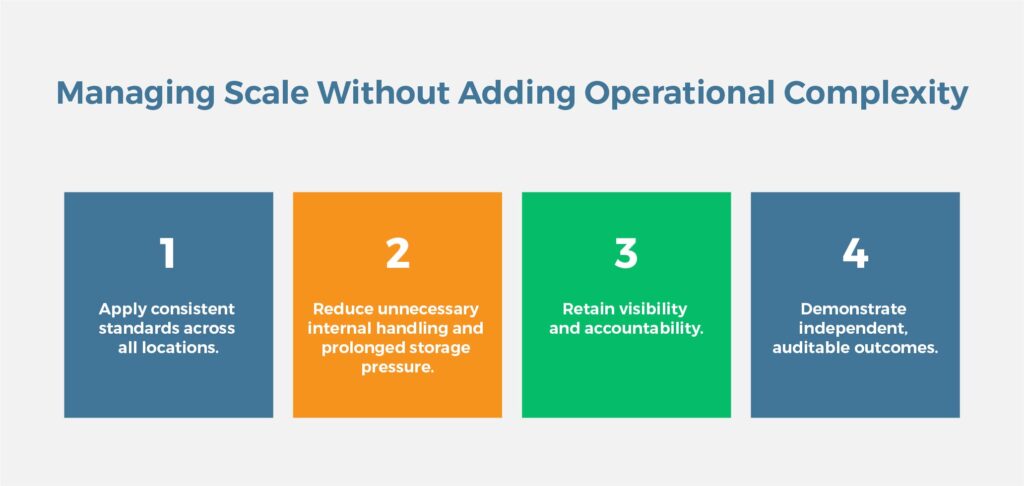
Specialist electronic lost property services allow rail operators to:
- Apply consistent standards across all locations
- Reduce unnecessary internal handling and prolonged storage pressure
- Retain visibility and accountability
- Demonstrate independent, auditable outcomes
The objective is not to centralise everything.
It is to standardise what matters.
Defensibility Over Optics
In highly visible public transport environments, governance decisions are rarely judged on how they appeared at the time.
They are judged on whether they can be evidenced later.
A defensible approach to unclaimed electronic lost property supports:
- Internal audit and assurance
- Data protection compliance
- Public trust and reputational protection
- Confidence for senior decision-makers
It allows rail operators to move from informal risk management to documented due diligence.
Conclusion
Managing electronic lost property across rail networks is not about adding policy layers or operational friction. It is about recognising when an operational process becomes a governance responsibility.
Rail operators that treat unclaimed electronic devices as ongoing custodianship challenges – rather than end-of-process afterthoughts – place themselves in a far stronger position.
Not because they expect scrutiny, but because if it comes, they can respond with clarity, evidence, and confidence.
Beyond compliance and governance, there is also a moral responsibility to the passengers whose personal data remains on these devices.


